Motion insights 30 July 2026 5 min read
What the **** is a motion system?
Depends who you ask. To most of the industry it's a chapter in the guidelines. To me it's a tool you can run.
Ask three designers
Ask three designers what a motion system is and you'll get three answers.
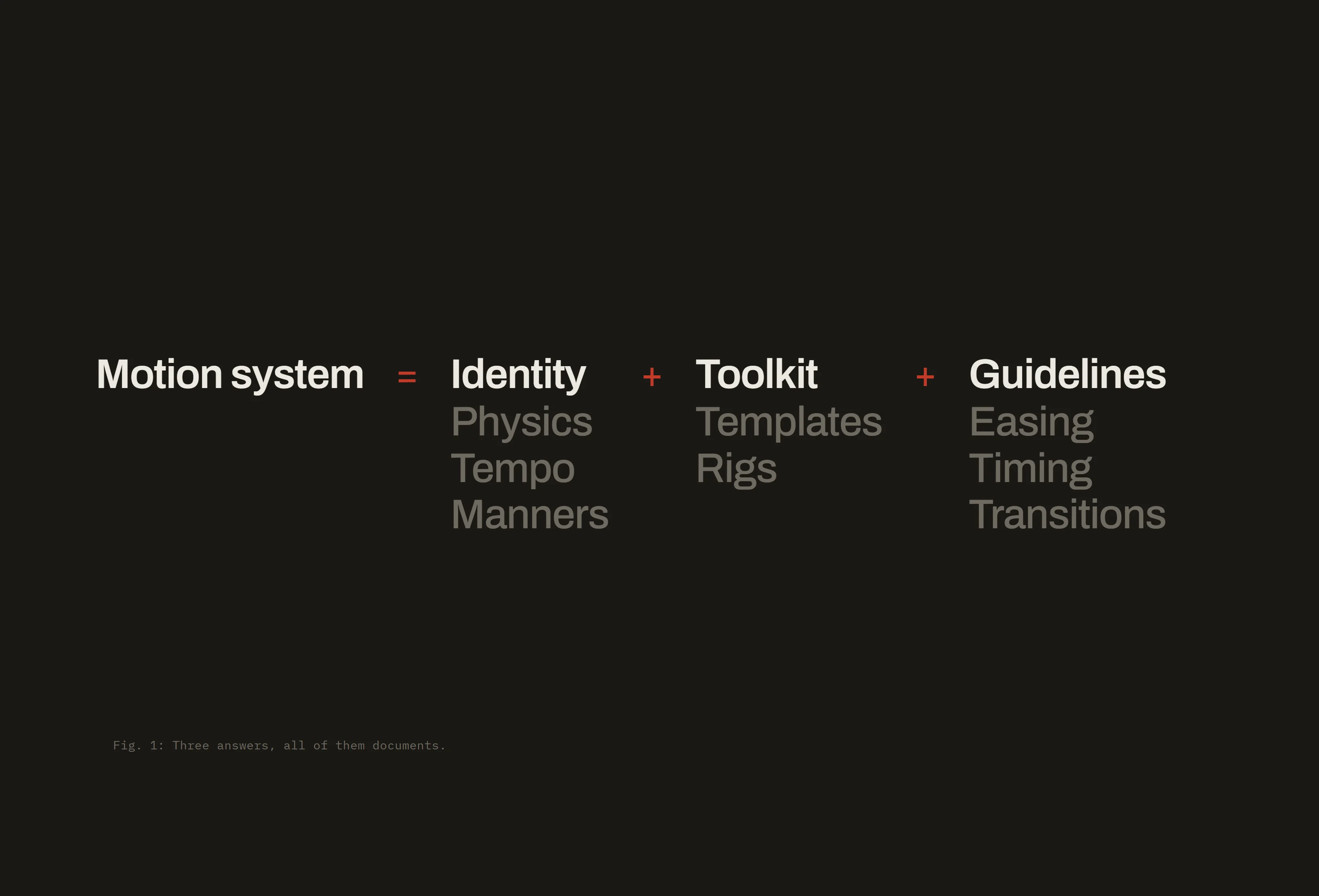
One means a motion identity: how the brand moves, its physics, its tempo, its manners. Another means a motion toolkit, a folder of After Effects templates and rigs that's useful on Monday and a cage by March. The third means the motion chapter of the guidelines, where the easing curves, timing scales and transition logic sit neatly documented.
All three are documents. None of them make anything.
Somebody still has to open the software on a Tuesday and do the work, and it's usually the designer who built the brand in the first place.
A motion system is a custom-built tool that turns your brand's rules into finished motion. New every time, on demand, without the donkey work.
A spec sheet describes the work. This does it.
The classical layer is still in there: the easing, the timing, the choreography. That part is table stakes now, automated into the product. You can have the guidelines PDF too, if you like. You won't open it. Nobody reads the manual for a machine that only does the right thing.
Why motion, and why now
Every channel that matters is motion-first. Static reads as furniture. Movement is what stops the thumb. Consistent, high-quality movement makes a brand feel bigger than its headcount, and heading into a raise or an exit, that perception has a price on it.
Motion is how a twelve-person company looks like it has a motion department.
The catch is production. Scale-up design teams are small and the feed is hungry every day. So the designers who built the brand end up as its production line: resizing, re-rendering, re-exporting. The boring, repetitive stuff, done by the people you hired for their eye.
The talent is fine. The tooling isn't.
Design the movement, then build the engine
Phase one is the motion identity. We decide how the brand moves, in the traditional sense: what does this identity look like once it moves? Its weight, its speed, its light. Design judgement, done with your designers. No machine gets a vote here.
Phase two is the engine. We encode those decisions into software. It's basically an app, with your rules baked in.
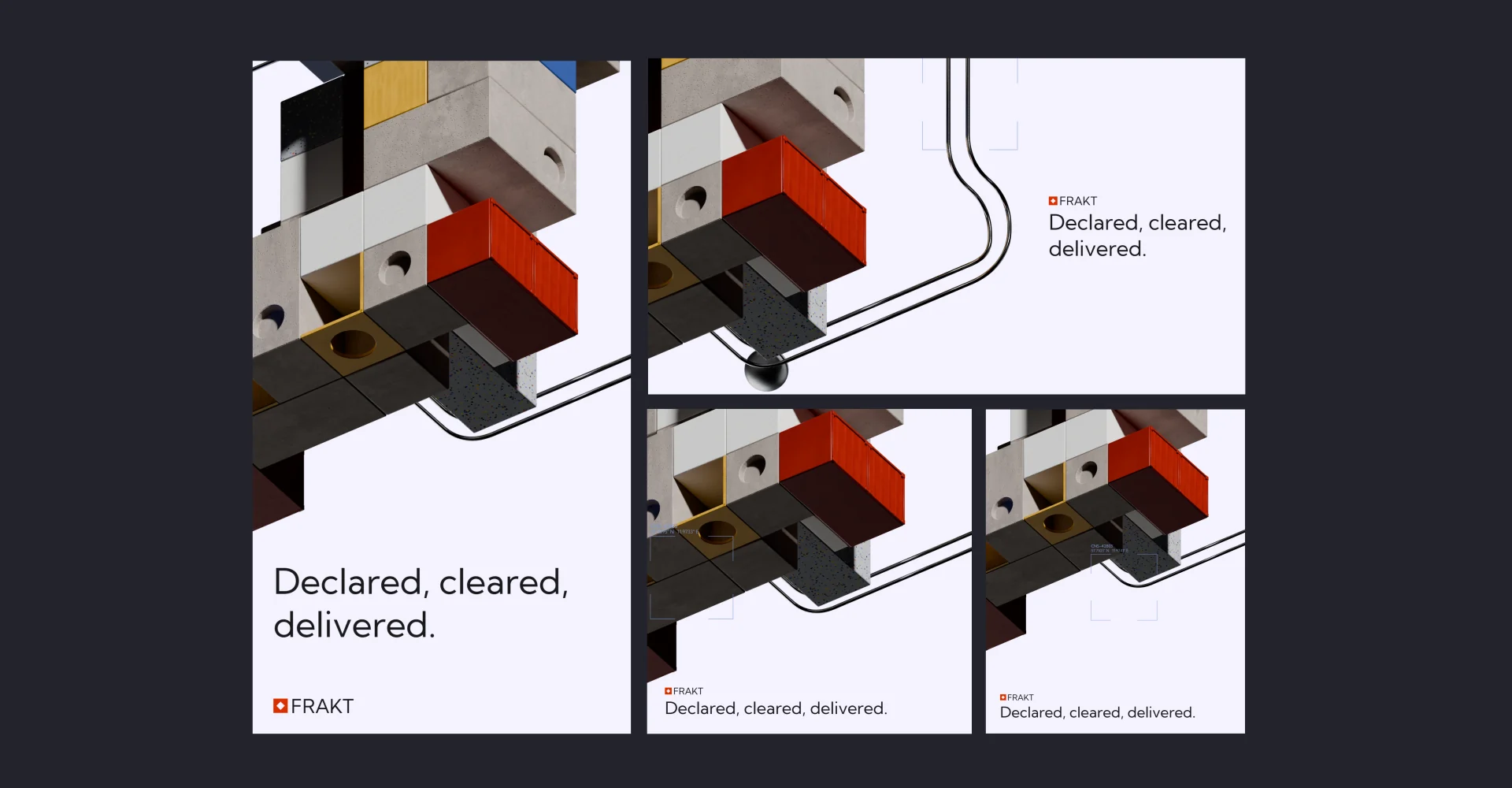
Press generate and it assembles a new composition from the brand's kit of parts: one nobody has seen before, and one that stays on-brand, because the brand's rules are the only vocabulary it has. Pick a format and the typography sets itself: scale, position, clearances, right down to the logo pinning itself to the correct corner. Render, and you have the finished article.
- Stills up to 2160px
- Smooth 30fps loops
- Square, 4:5, 16:9 and 9:16, each born native to its size, never cropped down from a master
Is it a template system? Essentially, yes. The same way a piano is a percussion instrument. A template gives you one layout with blanks to fill. An engine gives you thousands of finished, unrepeatable compositions. Better by a huge margin, for one reason: the rules live in the code, not in a checklist someone forgets.
It runs in a browser tab. No licences, no learning curve.
Built with AI. Runs without it.
There is no generative AI in the output. None.
The engine is deterministic. We teach it composition through code rather than prompts: explicit rules about what looks good and what's allowed, and you can read every one of them. Same brand in, on-brand out, every time. No hallucinated logos, no drift, no monthly model bill.
Where AI earns its keep is the build. Tools like this used to need a specialist engineering team, which is why festivals, museums and universities were mostly the ones commissioning them. What took weeks now takes hours. That collapse in cost is the only reason a scale-up can afford a bespoke engine of its own.
AI made the economics work. It gets no vote on the creative.
We invented a freight brand to prove it
FRAKT is a Scandinavian freight brand we invented. No ships, no depots. We made it up so we could prove the approach on an identity with real weight, without a client NDA in the way.
The system behind it is entirely real. Every image and film in the case study was generated, typeset and rendered by the engine: a full brand platform, a service campaign, and the films between them. Untouched.
It also has a Build mode, for when a designer wants to place parts by hand: the system routes the rails, keeps the physics honest and won't let a layout break the brand.
A month of social in an afternoon
- Variations are free, so you generate, pick, render, post.
- A/B testing creative the way you test copy. When a variant costs nothing, results steer the art direction instead of opinion.
- Launch-day agility. New offer, new market, new claim: type the line, pick the format, render.
- Event screens, pitch decks, a film for every product line.
Blunt version: an engine does roughly the year's output of a junior motion hire, for a one-off fee, while your senior designers go back to being designers. They keep the compositional eye; the engine does the donkey work.
An engine won't invent your brand.
It suits identities built from type, objects and constructed worlds. If your brand lives entirely on one-off illustration or live-action film, an engine helps less.
I didn't invent the idea. A handful of studios have built bespoke engines for years, and the big platforms now sell AI-trained versions to enterprises on subscription. The gap has always been the middle. That's who we build for: deterministic engines a scale-up can afford and own outright.
No seats, no subscription. You pay for the identity and the build, and the tool is yours. Outgrow it, hand it back, we'll extend it.
Phase one is design judgement, and it stays that way. The engine only ever works inside the rules set in phase one. Constraint is what consistency is made of. The motion identity and the guidelines are still the starting point. The engine is what finally makes something from them.
Worth twenty minutes
If your designers built the brand and now spend their weeks feeding it, this is the problem a motion system removes.