Motion insights 17 August 2026 6 min read
Motion for the moments that matter
A flagship event is the most eyes you will ever have on your company in a single moment. What's on the screens should act like it.
One true focal point a year
Most companies get one true focal point a year. The conference, the summit, the launch: usually annual, always singular. Everyone who cares about you is watching, and so are plenty of people who barely know you exist.
You will never have more eyes on you in a single moment than this.
Which makes the event screens a strange place to save money. This is the one day you get to show what you're building and why it matters, and to do it well enough that any old Joe off the street looks up and goes: that's pretty cool. Miss it and you wait a year for the next one.
Look bigger, or look interesting
For a scale-up, the event is a chance to look bigger than you are. If you're eyeing investment or an acquisition, you want to look as big as possible, and premium creative is how that's done. Motion is how a twelve-person company looks like it has a motion department. An event is that department performing live, in front of the exact people you most need to convince.
The titans have the opposite problem. Nobody needs IBM or Meta to look bigger. Their trouble is that nobody outside the space finds the products interesting: people use them constantly and think about them never. So the fight is against the corporate spiel. Apple gets millions of views on a product feature because it found a style and a voice, and it spends as heavily on how it talks as on what it ships. In industries run by a handful of giants, setting that standard is the competition.
Either way, the fight is won or lost on the event screens. Eyes go to the thing that moves. That's human wiring, and everyone in the room is running it.
Movement also carries a signal. You could have hung a static backdrop and nobody would have complained. You did more, and an audience reads effort as belief. For a scale-up especially, it says these people are invested in what they're building, and the room clocks that before anyone has said a word.
Sales was still using it months later
On a budget sheet, an event is one day of spend. In practice the work keeps going once the chairs are stacked: the opener gets clipped for socials, the product films go to YouTube and into launch posts, and the same pieces sit on the website doing quiet work for months.
Months after JoyConf (the flagship event of Storyblok, the content management platform), its sales team was still running the product films we made, privately with prospects and in their own LinkedIn posts. Turns out a good product film teaches the people selling it as much as the people buying it.
When the film can explain the feature to your own sales team, it has stopped being staging and started being infrastructure.
So weigh the cost against the year of use.
The deadline doesn't move
A campaign can slip a week and nobody outside the building notices. An event date is public, ticketed and immovable.
The show happens whether you're ready or not.
Companies should walk in knowing that, because it shapes everything: who you hire, when you brief them, how much last-minute change the work can take. Ideally you give it a month or two of runway. Reality usually gives you less. On JoyConf, both product features were still in the workshop a fortnight out, which left roughly a week per film. Blunt version: absorbing that kind of squeeze is part of the job. It costs a multiple, and we can do it.
The pressure carries on past delivery. Show day stays live until the closing sequence: speakers drop out, running orders shift, edits land that morning. The files ship, and then you stay on call.
The bits nobody budgets for
The opener always gets a budget line. The gaps between things rarely do, and the gaps are where a room decides whether the day feels designed or assembled: waiting screens, speaker stings, transitions, walk-in loops. We make every state the screens can be in look like it came from the same hand, so the day plays as one designed thing instead of a playlist.
Ambient screens run short loops with no visible join, at the wall's native resolution, in whatever format the playback rig wants, at a frame rate that stays smooth at scale. The trick is making a loop feel alive on its fortieth repeat without stealing focus from whoever's talking.
We took that all the way to the failure state. For JoyConf we made a 404 screen, in case anything broke.
When even the technical difficulty is art-directed, nothing can knock the event off-brand.
Designing for an LED wall
Where we sit: we make what plays on the screens, inside whatever environment the venue hands us. The hardware and the staging belong to other people. That environment turns out to be most of the technical craft.
An LED wall is a custom canvas. Its native resolution is set by the venue's panels and their pixel pitch, and it's usually an odd number that matches no standard format. You design to that exact pixel map; stretch a 16:9 master across it and the visuals arrive soft. On a screen fifteen feet across, everything gets mastered in 4K so the quality holds at that size.
Pitch also decides how close someone can stand before the image falls apart, roughly a metre of clean viewing distance for every millimetre of pitch, and that changes the design itself. Type that sings on a laptop dies from the third row. So: bold forms, high contrast, fewer words.
Colour misbehaves out there too. An LED wall gives off its own light, so it pushes colour and runs bright, and it never quite matches the monitor you designed on. You balance for the room, then balance again for the cameras, because most events now have a second audience on the stream. A wall that looks gorgeous to the eye can blow out the feed behind a speaker's face.
And then the multiplication. JoyConf ran in Amsterdam, LA and New York, each with a different wall, so every piece needed a version per city: re-laid-out, adjusted, re-rendered. That's the real grunt work of event motion.
The grunt work is buildable.
That multiplication is exactly the class of problem I build systems for. Re-formatting per venue is deterministic donkey work: same rules, different canvas. I couldn't build an engine for it at the time. I could now. Bake the event identity into a tool, hand it to the company, and the next venue or the last-minute schedule change gets handled by their own people in minutes, with nothing breaking the brand. The creative gets made once. The repetition gets automated.
One day a year
In October 2025 we built the full motion setup for Storyblok's JoyConf 2025, its first flagship event and the first it had run itself. The opener was designed to go a bit wow: fireworks inside the first few seconds, because we wanted phones out of pockets before the first speaker walked on, and a bright fantasy-tech world, all 3D. Two product films, for two Storyblok features, FlowMotion and Strata. And the full ambient set, right down to that 404.
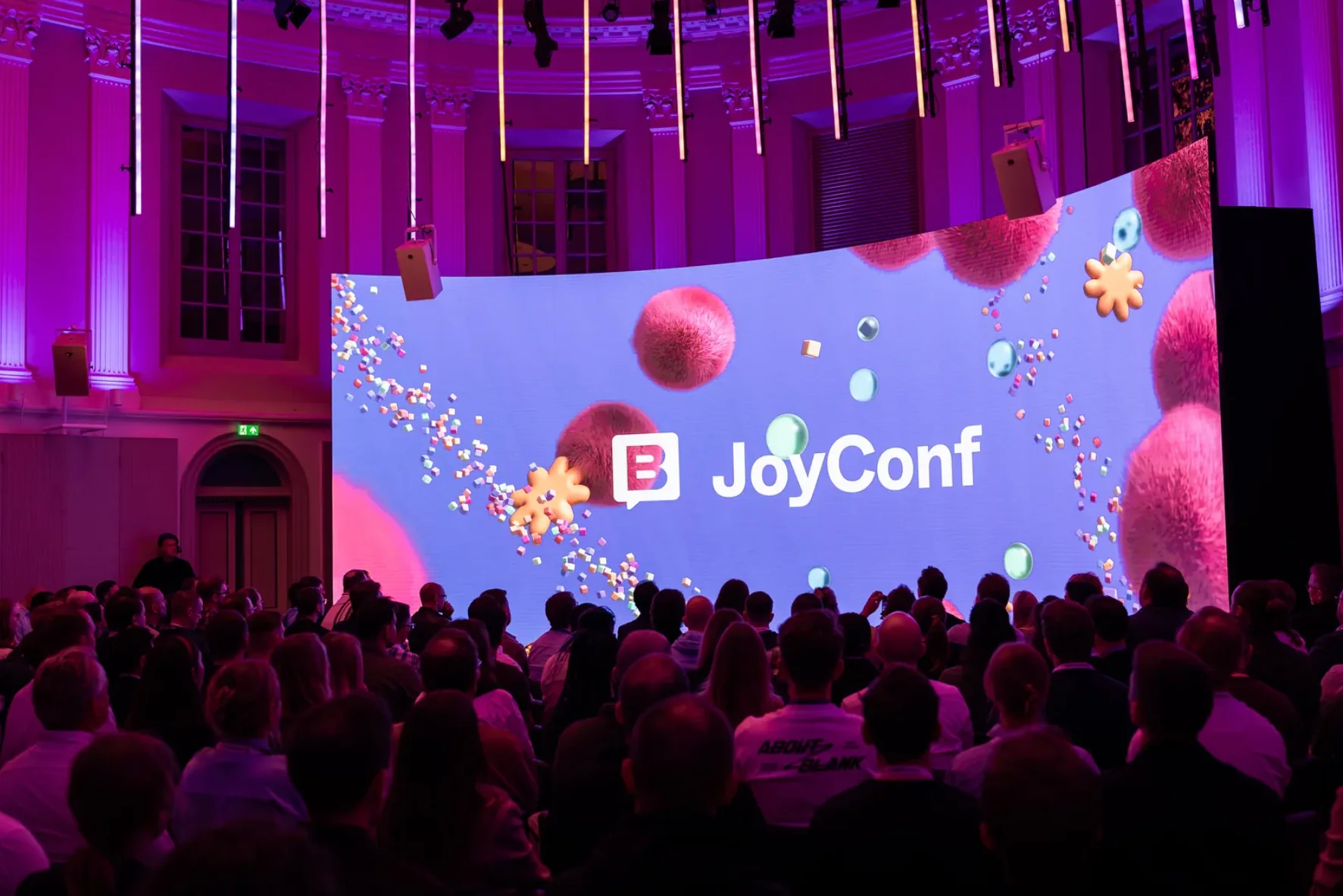
The best openers are short, loud and gone before anyone's ready, and they leave the room wanting more. Which is a decent brief for the whole event. JoyConf's opener ran on that brief: fireworks for the room, and gone before the first speaker walked on.
You get one day a year with this many eyes on you. The work it produces keeps earning long after the room empties.
Make it move.