Thinking 16 August 2026 6 min read
What is art? The brushstroke, or the vision?
What makes something art: the craft, or the idea behind it? The artist Marcel Duchamp asked it with a urinal a century ago. AI has made it urgent again, now that the execution can be handed to a machine.
Two arguments in one fight
The argument about AI in creative work has settled into two camps. One calls it theft and slop. The other says adapt or die. I have some sympathy with both, and I think two separate questions are knotted together in the noise.
The first is consent. These models learned from artists' work without asking, and there's no trail back to what came from where. That's a fair grievance, and a more tangled one than it looks, since learning from other people's work is how most of us started.
The second question is much older: where the art actually lives. Call it the brushstroke or the vision. The brushstroke is any technical skill, the keyframe as much as the paint. The vision is the intention behind the work. If art lives in the skill, AI has just learned to make it.
So which is it: the brushstroke, or the vision?
A urinal in an art show
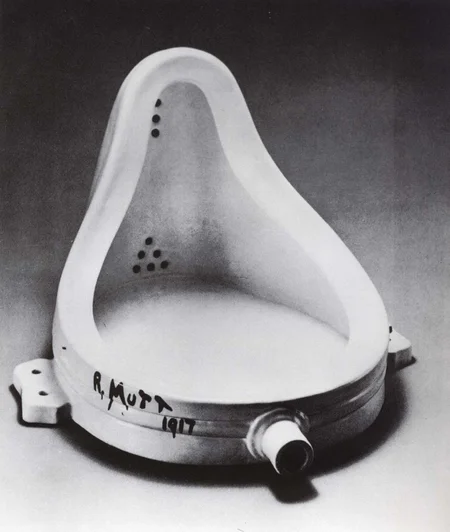
I sit mostly with the postmodernists on this, and the example that stuck with me from art class was a urinal. In 1917, Marcel Duchamp (the French artist often called the father of conceptual art) submitted one to a New York art show, signed with a name that wasn't his. The show wouldn't hang it. Fifty years later he said:
It's not the visual aspect of the Readymade that matters, it's simply the fact that it exists.
Marcel Duchamp
For Duchamp, the art lived in the decision: choosing this object and insisting it counted. That's where I'd put it too. The skill matters, and it's often extraordinary, but the art is in the intention: what the work is trying to say, and why it says it this way.
Doesn't that let the prompt in?
If the art is in the vision, and a machine can now supply the skill, then a good enough prompt should be art.
Sometimes I think it can be. Inside a real creative process, with someone choosing, rejecting and refining, AI is a tool like any other. Even Ted Chiang (the science fiction writer whose story became the film Arrival), no fan of AI art, allows that someone steering a generator closely enough could still deserve to be called an artist. His example is a film director who generated more than a hundred thousand images to keep twenty.
A video generated start to finish is a different thing. The intention in it is thin: a line of text, and the model fills in the rest from what it has seen before. The small decisions that turn an idea into a vision get made by the model instead of a person. For now, the output is weaker too.
Coca-Cola showed what that looks like with its generated Christmas ad. It was fluent and it was hollow, and as I put it at the time, Coca-Cola had just made the most profitable advert in Pepsi's history. That's the value I see in human toil: the deciding, and the fact that someone did it.
The connection is in knowing someone made the decisions.
Tell me you've never copied from Pinterest
To be fair, though. Designers, artists: tell me you've never saved someone's work on Instagram or Pinterest and started your own piece by imitating it, even a little. The human process and the machine one are close cousins.
One difference is traceability. When I borrow, I know whose work I'm borrowing from, and so does anyone who has seen the original. A model borrows from millions of people at once and can't say which.
The other is what happens next. When I imitate a reference, I still make every call about what to keep, and my own taste bends it somewhere new. Ten designers copying the same Pinterest board still end up in ten different places.
A model runs the other way. It averages everybody's taste into one picture and hands that picture to everyone who asks. The effect has been measured: researchers at New York University found in 2024 that when people wrote with an instruction-tuned model, essays by different writers came out noticeably more alike than when they wrote alone.
Photography faced the same charge
Photography went through the same argument. It was dismissed as a machine doing the painter's job, until people saw where the decisions had moved: into where you stand, what you wait for, which frame you keep.
Walter Benjamin (the German critic who wrote about art in the age of mass reproduction) noticed something about that fight in 1935. Critics had spent decades asking whether photography was art. Almost nobody asked the bigger question: whether photography had changed what art was.
It had. Painting handed over much of the job of recording the world, and went looking for what only a painter could do. I expect the same from AI. The skill it can supply will stop being where anyone looks for the art, and the vision will matter more.
The fear is really about craft
Under the anger sits a fear I understand: that the work will be replaced. AI's potential worries me too, mostly as fear of the unknown, and I think that fear is why the disdain spreads so easily online. People see their livelihoods at risk. I've put the hours into getting on top of AI, and that has calmed my own fear somewhat.
The people condemning AI outright will be wrong, as the people condemning new technology always have been. Nobody now wants to get rid of the internet. In twenty years AI will feel the same.
Plenty of people who call themselves creatives have spent their careers being told what to draw, what to design and what to build. They've developed serious technical skill, and they've called that skill creativity, because the industry let them.
That skill is the brushstroke, and the brushstroke is exactly what a machine is learning to supply. The vision is much harder to hand over.
Where the vision comes from
So, the brushstroke or the vision? The vision. But a vision is more than an idea typed into a box. It gets formed in the making, by someone choosing, testing and choosing again until the work says what they meant.
It also marks the line between design and art. A design answers to the person using it: why is the teapot's spout that length, and can the material take the heat? Nobody interrogates a painting that way.
Motion sits on both sides of that line, and some of it clearly makes the leap. Animated film and stop motion demand great depths of craft and artistry at once: years of technical skill, spent on a story that has to make you feel something.
Branding, product visuals and UI design work differently. They're made for a purpose, and that purpose can be scrutinised. Does the interface make sense? Does the product film explain the feature? A fictional story can't be judged like that, and neither can a moral one. What it reaches for is connection and emotion, beyond the fit between form and function.
That's the part I'd least expect a machine to find on its own. A model can produce a piece that does its job. The connection a story invokes has to start with a person. Where exactly the line sits will keep moving, as it did when the camera arrived, and I'm happy to keep asking.
AI can have the brushstroke. The vision still needs someone to mean it.